Semantic Desktop
Question: How to guess users intention for a scientific process? What is the users intention?
The paramus internal desktop produces and logs events. Individually, these events have very little meaning. The important step is to map UI objects → concepts → activities.
Instead of asking the user to explicitly document every transition, the system can infer a changing activity context from interaction semantics while retaining the distinction between observed facts and inferred intent.
Example
This example was created live from a 10 minutes session with paramus.
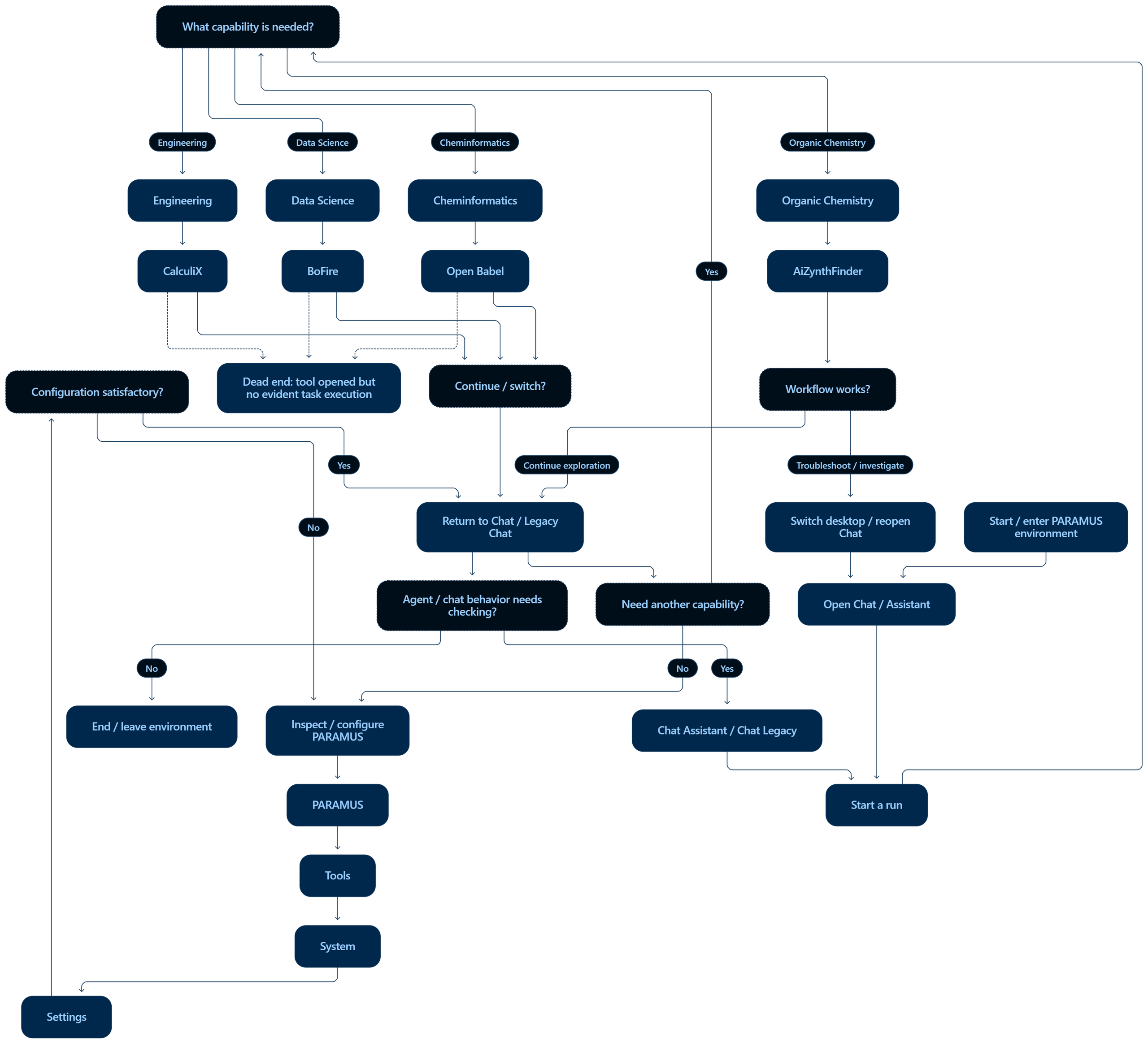
The desktop is effectively becoming a sensor for the scientist’s workflow state.
This is a useful example of semantic logging at the desktop level: the raw log records low-level interaction events, while the analysis reconstructs the user’s intentional activity from those events.
System Interpretation of the Example
Paramus’ interpretation (auto generated by the semantic desktop, original):
The user is stress-testing PARAMUS as a scientific operating environment: can an agent start from a conversational request, discover the appropriate domain capability, invoke a specialized scientific application, and then return to the agent layer to continue or redirect the workflow?
The logs do not establish that CalculiX, BoFire, Open Babel, or AiZynthFinder actually completed scientific calculations. They establish selection/navigation and repeated switching; the apparent “dead ends” should therefore remain explicit rather than being interpreted as successful executions.