
ISO 42001 AI Model Documentation
Organizations in regulated environments need a defensible record of the AI models they use: what each model does, who owns it, how critical it is, what risks exist, which controls apply, and when it was last reviewed. Paramus ISO 42001 gives teams a focused workspace for that evidence.
Why This Matters
In the EU and other regulated markets, AI governance is becoming a practical operating requirement. Teams need more than a list of models. They need a maintained management record that connects model purpose, owner, risk level, controls, incidents, audits, and review status.
- Regulatory readiness: maintain evidence that supports ISO/IEC 42001, EU AI Act preparation, quality systems, internal audit, vendor review, and customer due diligence.
- Model accountability: assign each model an owner, status, criticality, and review date so responsibility is visible before an audit or incident.
- Risk-based prioritization: separate low-impact tools from high-criticality models used in scientific, operational, or decision-support workflows.
- Control evidence: connect risks to controls and track whether controls are implemented, tested, and effective.
- Incident and audit memory: keep a structured record of findings, corrective actions, and follow-up dates.
Pre-Seeded Scientific AI Models
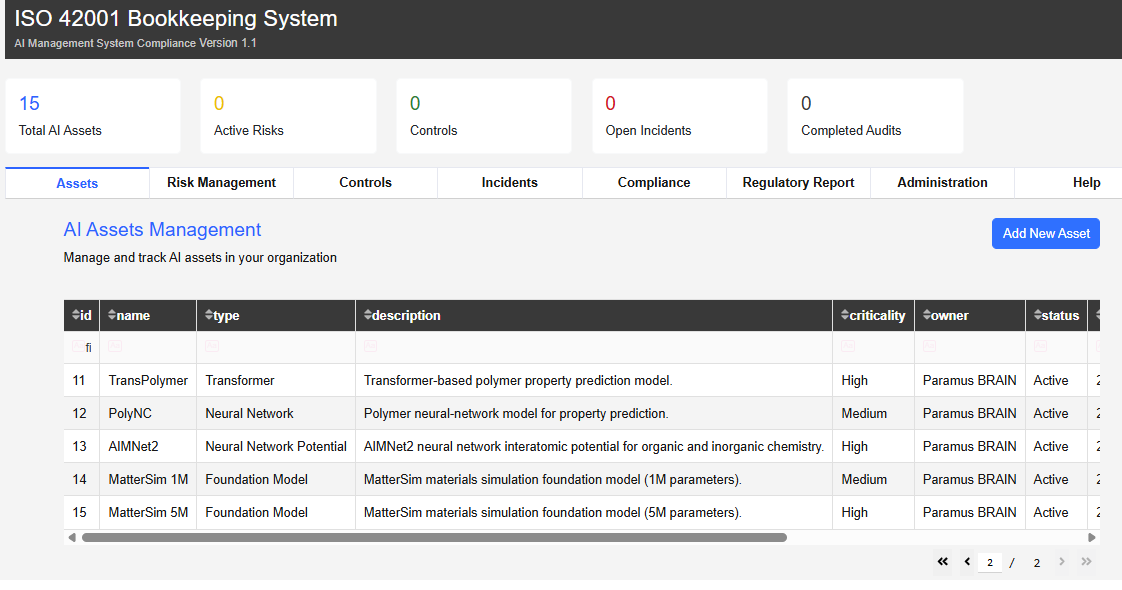
The app includes a starting inventory for Paramus BRAIN models so scientific teams can immediately document model criticality instead of starting from an empty register.
- High criticality: ORB Conservative variants, TransPolymer, AIMNet2, MatterSim 5M.
- Medium criticality: ORB Direct variants, PolyNC, MatterSim 1M.
Organizational Value
Paramus ISO 42001 creates a common record for scientific, quality, compliance, IT, and management teams. It reduces audit scramble by keeping AI model evidence current during normal work and supports risk classification across internal, third-party, and research models. It helps regulated organizations explain why a model is used, what it affects, which controls reduce risk, and how AI innovation fits into quality-managed operation.
FAQ
Who is this for?
Organizations that use AI models in regulated, quality-managed, audited, or customer-facing environments. This includes research, chemistry, materials science, manufacturing, healthcare-adjacent workflows, and enterprise AI governance teams.
Why is this especially important in the EU?
EU organizations face increasing expectations for AI transparency, risk management, human oversight, documentation, and accountability. A maintained AI model register helps teams show how models are governed in practice.
Does this replace legal or certification work?
No. It is an operational evidence system. It helps collect and maintain the records that legal, compliance, quality, and audit teams need to assess obligations and prepare for certification or inspection.
What is the main benefit over spreadsheets?
The records are connected. Assets, risks, controls, incidents, and audits sit in one system, so teams can trace a high-criticality model to its owner, mitigation plan, controls, findings, and next review.
Can it document scientific AI models?
Yes. The starting inventory includes Paramus BRAIN models such as ORB, TransPolymer, PolyNC, AIMNet2, and MatterSim, with criticality classes that can be reviewed and adapted by the organization.
What records should an organization keep for each model?
At minimum: purpose, owner, model type, intended use, criticality, review date, key risks, applicable controls, known incidents, audit findings, and status. Higher-risk models usually need more detailed validation and oversight evidence.