Four Graphs: How an AI Lab Knows What It Knows
A single measurement is not a result, and a result is not yet knowledge. Chemists know this. An AI agent does not: give it a folder of results and it treats one run as a fact and a plausible reading as an established one. The more autonomous the agent, the more that costs.
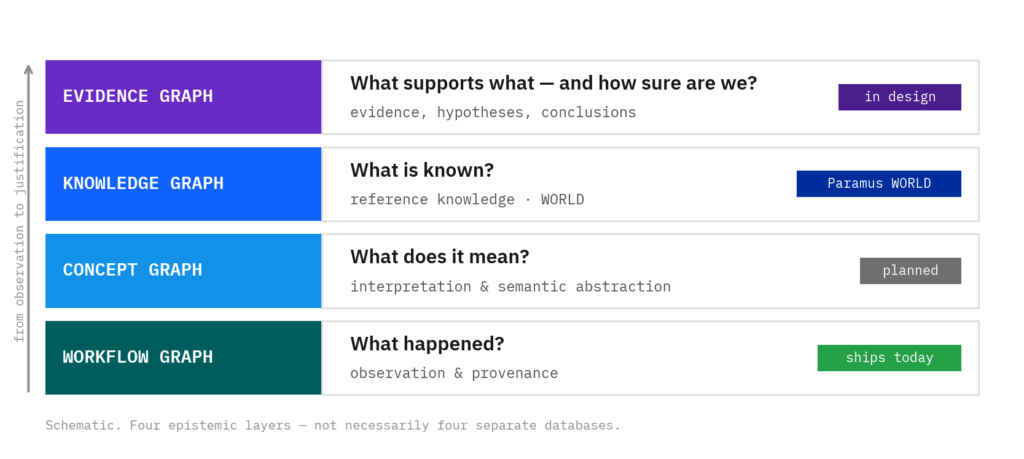
Paramus therefore keeps four kinds of statements apart, each in its own graph.
| Graph | Question | Kind of statement |
|---|---|---|
| Workflow graph | What happened? | Observation and provenance |
| Concept graph | What does it mean? | Interpretation |
| Knowledge graph | What is known? | Reference knowledge |
| Evidence graph | What supports what, and how sure are we? | Evidence, hypotheses, conclusions |
Workflow graph
The system’s record of its own actions: every run, tool call and gate decision, with agent, instrument, inputs, approver and output file. Nobody edits it and it does not interpret. When someone asks in six months how a number was produced, the answer is a query. This graph ships with every Paramus installation today.
Concept graph
Derived from the workflow graph, your files and your desktop activity, it identifies the concepts behind your work and how they relate: run #142 is about aspirin solubility, depends on temperature, and belongs with last month’s series in another project. Every node keeps its provenance, and the whole graph can be deleted and rebuilt from its sources.
Why not “context graph”? Context means projects, files and people around an activity, and that overlaps with the workflow graph. This layer derives concepts. The term “concept graph” is used in different ways in the literature, so in Paramus it means exactly this derived semantic layer. Status: planned.
Knowledge graph
Reference knowledge that is not renegotiated in every experiment: aspirin is an NSAID, ethanol is a solvent. In Paramus this is Paramus WORLD, a knowledge graph queryable with SPARQL and over MCP. Its integration as the reference layer of the OS is in progress.
Evidence graph
With the first three graphs, Paramus can say what was done, what it means and what is known. It cannot yet say why a conclusion is justified, or where it stops holding. Take a solubility series for aspirin in ethanol:
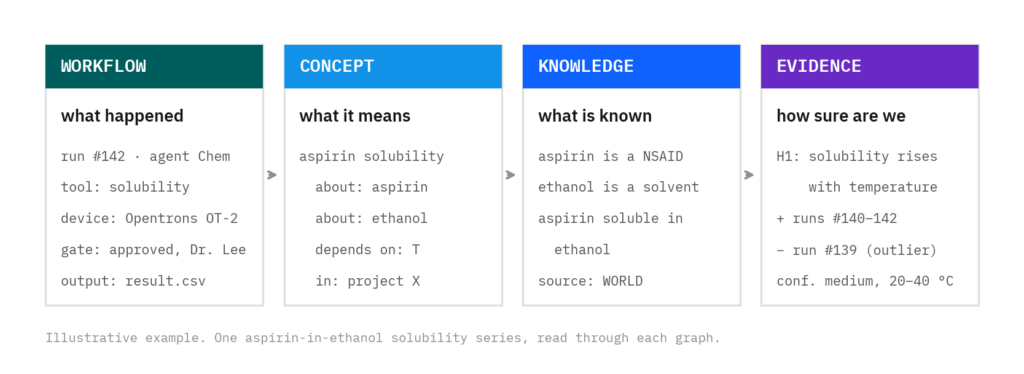
Runs #140 to #142 support the hypothesis that solubility rises with temperature, run #139 contradicts it, the reference data agrees. Confidence medium, valid for 20 to 40 °C. Only this reading tells an agent or a reviewer how far to trust the result.
The evidence graph has to hold evidence with its uncertainty, hypotheses as their own nodes, supporting and contradicting evidence side by side, the inference steps and models used, and confidence with validity conditions. Provenance itself is covered by W3C PROV-O, which deliberately stops short of scientific argument. Claim and evidence models such as Micropublications (Clark, Ciccarese and Goble, J. Biomed. Semantics 5:28, 2014, doi:10.1186/2041-1480-5-28) cover that part. Status: in design.
One vocabulary: the Science Ontology
The four graphs share one vocabulary, the Paramus Science Ontology. It names the things research work produces – workspaces, chats, files, datasets, results, analyses, agents, hypotheses – and how they relate, and it builds on established vocabularies: W3C PROV-O for provenance, schema.org, Research Objects, DCAT and the OBO ontologies IAO, OBI and SIO. The workflow graph is written in it today. Its hypotheses already carry a status from draft through tentative to confirmed or refuted, which is where the evidence graph starts.
The Science Ontology describes the research work, not the chemistry. What aspirin is belongs to the knowledge graph and to domain ontologies such as ChEBI. When the concept graph derives “aspirin” from a run, it links that node to the entity in WORLD: the Science Ontology says what kind of statement something is, the knowledge graph says what it is about.
Layers, not databases
The four graphs are epistemic layers, not necessarily four stores. The workflow graph stays a separate append-only record. The evidence graph may live as a qualified layer on the concept graph, since a claim is a concept with support relations, confidence and scope attached.
For agents this matters in practice. An agent that sees “supported by three runs, contradicted by one, valid up to 40 °C” plans a better next experiment than one that sees a single number. A reviewer gets an argument to check, not a chat transcript.
All four graphs live on the local installation in open RDF. From Paramus 3.4, CENTRAL can consolidate them across a team, following each company’s data-compliance rules.
More: Paramus WORLD
FAQ
The workflow graph (what happened), the concept graph (what does it mean), the knowledge graph (what is known) and the evidence graph (what supports what, and how sure are we).
The workflow graph records observations and provenance: every run, tool call and gate decision. The evidence graph weighs them: hypotheses, supporting and contradicting evidence, confidence and the conditions under which a conclusion holds.
Context means the projects, files and people around an activity, which overlaps with the workflow graph. This layer derives concepts and their relations from your work, so in Paramus ‘concept graph’ means exactly this derived semantic layer.
The shared vocabulary of the four graphs. It names what research work produces – workspaces, chats, files, datasets, results, analyses, agents, hypotheses – and builds on PROV-O, schema.org, Research Objects, DCAT and the OBO ontologies IAO, OBI and SIO.
Not necessarily. They are epistemic layers. The workflow graph stays a separate append-only record; the evidence graph may live as a qualified layer on the concept graph. All four live on the local installation in open RDF.