Paramus Opentrons
UI (Human) Applications MIT (Free)
About
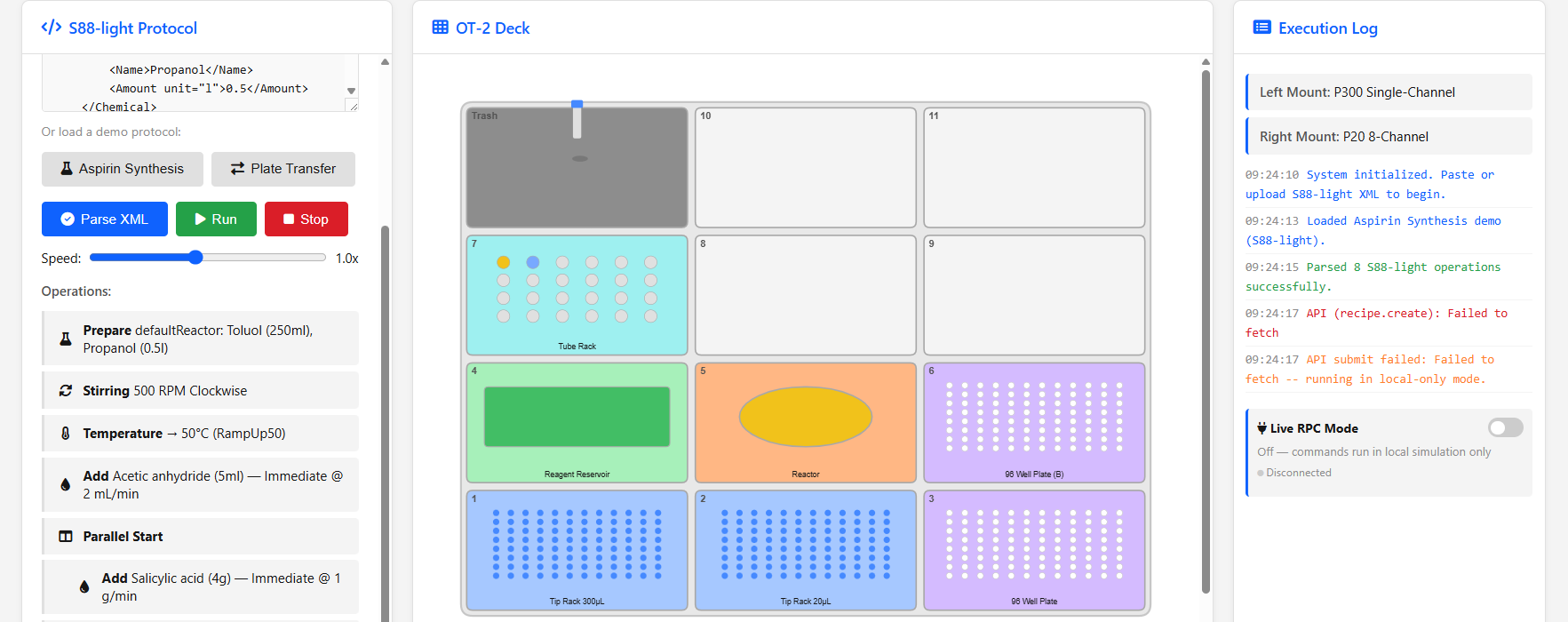
Opentrons liquid handling robot protocol designer and runner. Author Opentrons protocols (.xml, .s88) and submit them to OT-2 / Flex devices.
Key Features
- Opentrons protocol editor
- Supports .xml and .s88 file types
- Run management for OT-2 / Flex
- File handover via XML query
- Workbench-integrated execution
Frequently Asked Questions
What is Paramus Opentrons?
Paramus Opentrons is a ui (human) applications application available in the Paramus App Store. Opentrons liquid handling robot protocol designer and runner. Author Opentrons protocols (.xml, .s88) and submit them to OT-2 / Flex devices.
Is Paramus Opentrons free to use?
Yes. Paramus Opentrons is distributed under the MIT (Free) license and is available at no cost through the Paramus App Store.
How do I install Paramus Opentrons?
Paramus Opentrons is installed through Paramus Chemistry OS, an on-premise Windows platform for computational chemistry. Open the Paramus App Store in your local installation and select Paramus Opentrons for one-click deployment.
What are the key features of Paramus Opentrons?
Key features of Paramus Opentrons include: Opentrons protocol editor; Supports .xml and .s88 file types; Run management for OT-2 / Flex; File handover via XML query.
What type of application is Paramus Opentrons?
Paramus Opentrons belongs to the “UI (Human) Applications” category in the Paramus App Store. It runs on Paramus Chemistry OS and can also be accessed through Paramus Cloud for supported workflows.
What platform does Paramus Opentrons run on?
Paramus Opentrons runs on Paramus Chemistry OS, a Windows-based on-premise platform that provides local compute power for demanding simulations. It requires a Paramus OS installation with appropriate hardware resources.
Can Paramus Opentrons be automated or integrated with AI workflows?
Yes. Paramus Opentrons is available as part of the Paramus ecosystem which supports MCP (Model Context Protocol) tools for AI-driven automation. This enables integration with large language models and automated research pipelines.