MCP Server Setup
Paramus Chemistry OS includes a Model Context Protocol (MCP) server that exposes 290+ computational chemistry tools to AI assistants. After starting the application, your AI client connects directly to the local MCP server — no cloud services, no API keys, no configuration files.
Supported Clients
- VS Code (GitHub Copilot)
- Claude Desktop
- Windsurf
VS Code
After start, VS Code automatically detects the MCP server and shows available tools.
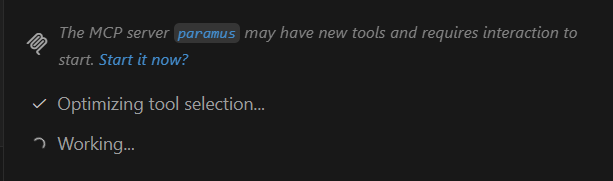
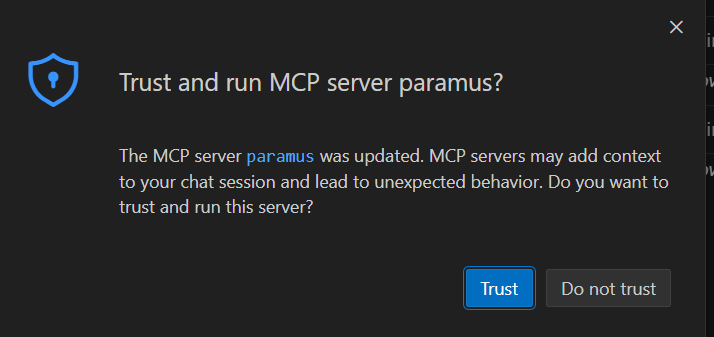
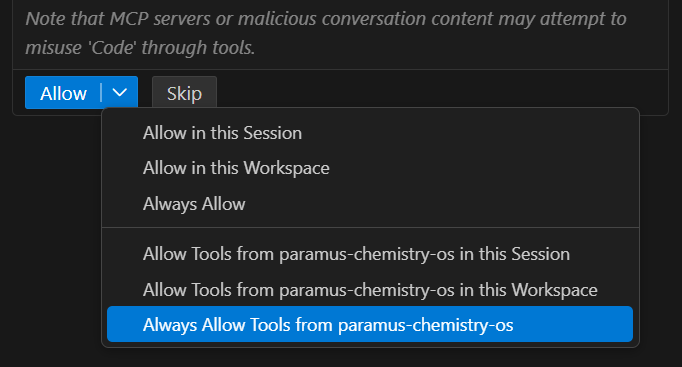
On the first run VS Code will ask for permission. Allow Paramus Chemistry OS to run whenever needed, otherwise you will be asked every time:
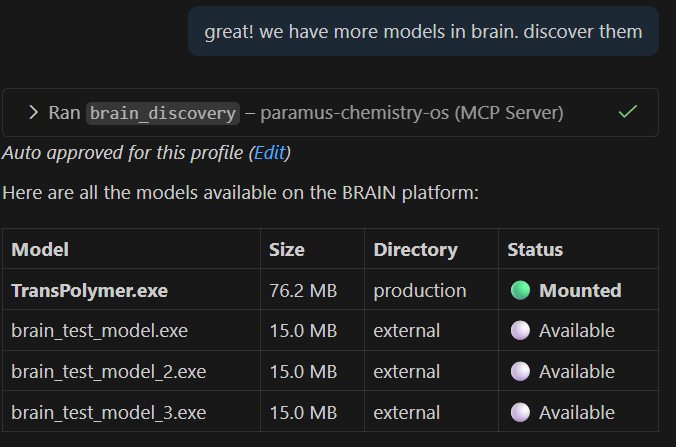
Example with Paramus Brain
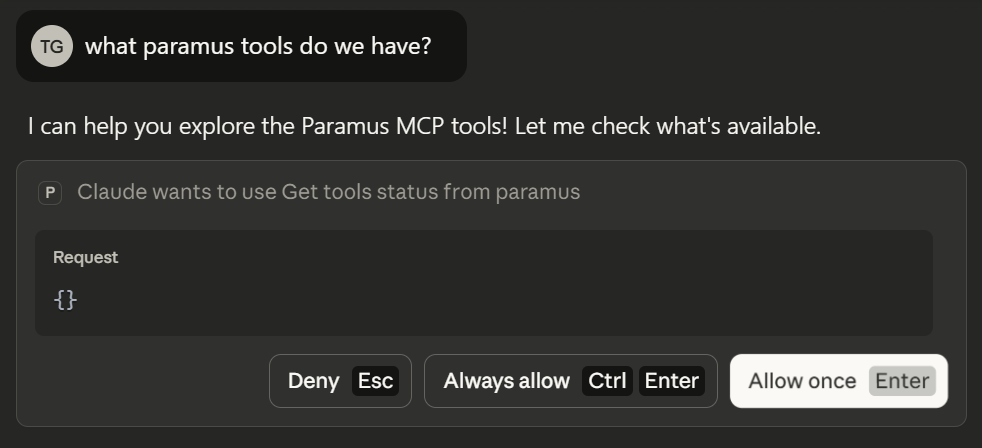
Claude Desktop

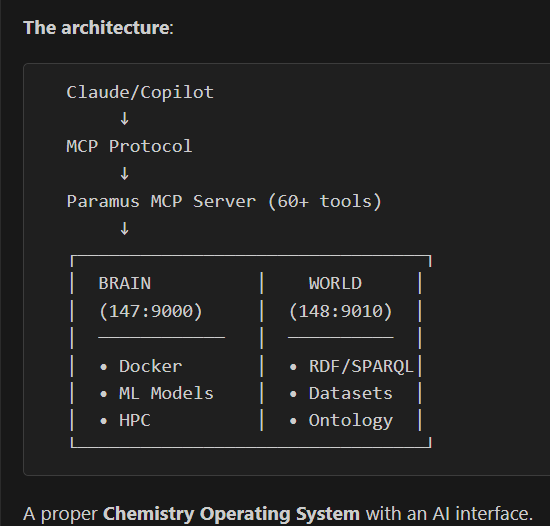
How the System Reports About Itself
Frequently Asked Questions
A Model Context Protocol server that exposes 290+ computational chemistry tools to AI assistants. It implements the open MCP standard for tool integration with large language models.
Claude Desktop, VS Code, Cursor, Windsurf, and any application implementing the Model Context Protocol standard.
SMILES/InChI conversion, 3D structure generation, DFT calculations, molecular dynamics, property prediction (LogP, pKa, solubility), spectroscopy, SPARQL queries, dataset search, and laboratory instrument control.
Download Paramus Chemistry OS for Windows. After start, VS Code automatically detects the MCP server. Allow Paramus Chemistry OS to run when prompted, and all 290+ tools become available in your AI assistant.
The MCP server protocol interface is open. The server connects to the Paramus Chemistry OS backend which provides the actual computation engines, knowledge graph, and laboratory control.