
PrexSyn
Computing Applications (HPC) MIT Academic (Partial)
About
A synthesizability-constrained generative molecular design framework using a GPT-style decoder-only transformer. Enables projection of any molecule into the Enamine REAL chemical space to find synthesizable analogs from a space of 40B+ molecules.
Skills
MCP skills available for PrexSyn, callable from AI workflows and the Paramus chat:
- Health — Health check for PrexSyn service including server, Docker, and image status.
- Info — Get PrexSyn service status, Docker availability, and image information.
- Methods — List all available PrexSyn JSON-RPC methods.
- Optimize — Oracle-guided molecular optimization. Iteratively optimize molecules toward a target property using built-in oracles (QED, LogP, SA score) or custom Python oracle code.
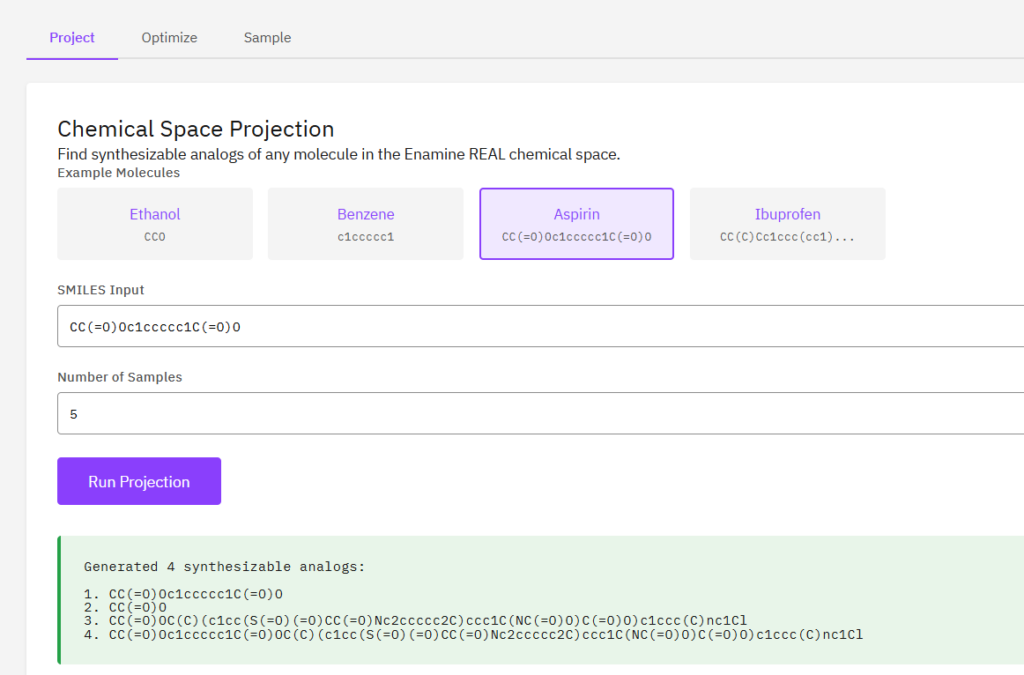
- Project — Generate synthesizable analogs of a molecule using PrexSyn projection. Maps input SMILES to the model’s learned chemical space to find similar synthesizable compounds.
- Sample — Unconditional or property-conditioned molecular sampling. Generate novel molecules from the learned chemical space, optionally constrained by property conditions.
- Server Restart — Restart the PrexSyn persistent server.
- Server Start — Start the PrexSyn persistent server via Docker Compose.
- Server Status — Get PrexSyn container state and HTTP readiness status.
- Server Stop — Stop the PrexSyn persistent server.
- Version — Get the PrexSyn version from the Docker image.
Browse the full PrexSyn skill documentation
Academic license from MIT. Commercial use requires separate agreement.
Citation
Luo, S. & Coley, C.W. Synthesizability-Constrained Generative Molecular Design. arXiv:2512.00384 (2024). DOI:10.48550/arXiv.2512.00384
Frequently Asked Questions
What is PrexSyn?
PrexSyn is a computing applications (hpc) application available in the Paramus App Store. A synthesizability-constrained generative molecular design framework using a GPT-style decoder-only transformer. Enables projection of any molecule into the Enamine REAL chemical space to find synthesizable analogs from a space of 40B+ molecules.
What license does PrexSyn require?
PrexSyn is distributed under the MIT Academic (Partial) license. Commercial use may require a separate license. License compliance is verified during Paramus OS registration.
How do I install PrexSyn?
PrexSyn is installed through Paramus Chemistry OS, an on-premise Windows platform for computational chemistry. Open the Paramus App Store in your local installation and select PrexSyn for one-click deployment.
What type of application is PrexSyn?
PrexSyn belongs to the “Computing Applications (HPC)” category in the Paramus App Store. It runs on Paramus Chemistry OS and can also be accessed through Paramus Cloud for supported workflows.
What platform does PrexSyn run on?
PrexSyn runs on Paramus Chemistry OS, a Windows-based on-premise platform that provides local compute power for demanding simulations. It requires a Paramus OS installation with appropriate hardware resources.
Can PrexSyn be automated or integrated with AI workflows?
Yes. PrexSyn is available as part of the Paramus ecosystem which supports MCP (Model Context Protocol) tools for AI-driven automation. This enables integration with large language models and automated research pipelines.
How should I cite PrexSyn in publications?
The recommended citation for PrexSyn is: Luo, S. & Coley, C.W. Synthesizability-Constrained Generative Molecular Design. arXiv:2512.00384 (2024). DOI:10.48550/arXiv.2512.00384