

OpenQBMM
Computing Applications (HPC) GPL-3.0 (Free)
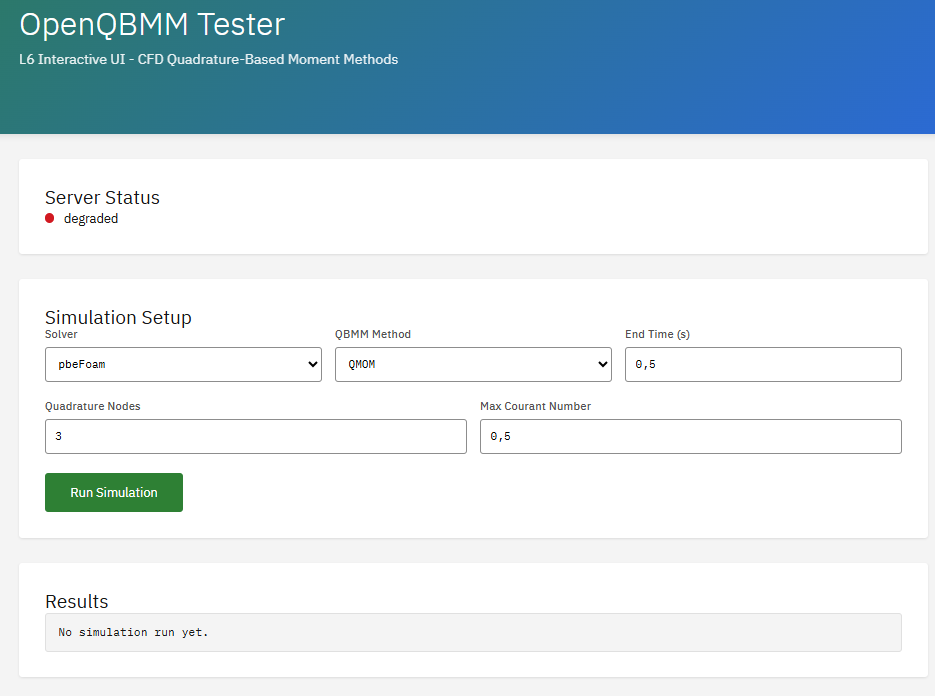
About
A solver suite for polydisperse multiphase flows using Quadrature-Based Moment Methods (QBMM). Requires OpenFOAM as base platform. Enables simulation of population balance equations, particle size distributions, spray atomization, and aerosol dynamics.
Skills
MCP skills available for OpenQBMM, callable from AI workflows and the Paramus chat:
- Analysis Info — [info-only, does not execute] Get documentation for OpenQBMM post-processing and analysis capabilities
- Analyze Convergence — Analyze convergence from OpenQBMM simulation.
- Analyze Moments — Analyze moment data from OpenQBMM simulation.
- Health — Check the health status of the OpenQBMM HPC service including Docker container availability, resource usage, and active simulations.
- Info — Get information about the OpenQBMM installation including version, available solvers, quadrature methods, and supported features.
- Kernel Execute — Execute commands in an active OpenQBMM kernel session. Supports OpenFOAM utilities, mesh generation, solver execution, and post-processing.
- Kernel List — List all active OpenQBMM kernel sessions with their status and resource usage.
- Kernel Start — Start a persistent OpenQBMM kernel session for interactive population balance modeling. The kernel maintains state between commands, allowing iterative case setup and execution.
- Kernel Stop — Stop an active OpenQBMM kernel session and release associated resources.
- Methods — Get available OpenQBMM methods.
- Simulate — Run OpenQBMM simulation (Layer 3).
- Simulation Info — [info-only, does not execute] Get documentation for OpenQBMM population balance simulation capabilities and solver options
- Steady State — Run OpenQBMM steady-state analysis.
- Transient — Run OpenQBMM transient simulation (alias for simulate).
Browse the full OpenQBMM skill documentation
Citation
Passalacqua, A. et al. An open-source quadrature-based population balance solver for OpenFOAM. Chemical Engineering Science. 176, 306-318 (2018). DOI:10.1016/j.ces.2017.10.043
Frequently Asked Questions
What is OpenQBMM?
OpenQBMM is a computing applications (hpc) application available in the Paramus App Store. A solver suite for polydisperse multiphase flows using Quadrature-Based Moment Methods (QBMM). Requires OpenFOAM as base platform. Enables simulation of population balance equations, particle size distributions, spray atomization, and aerosol dynamics.
Is OpenQBMM free to use?
Yes. OpenQBMM is distributed under the GPL-3.0 (Free) license and is available at no cost through the Paramus App Store.
How do I install OpenQBMM?
OpenQBMM is installed through Paramus Chemistry OS, an on-premise Windows platform for computational chemistry. Open the Paramus App Store in your local installation and select OpenQBMM for one-click deployment.
What type of application is OpenQBMM?
OpenQBMM belongs to the “Computing Applications (HPC)” category in the Paramus App Store. It runs on Paramus Chemistry OS and can also be accessed through Paramus Cloud for supported workflows.
What platform does OpenQBMM run on?
OpenQBMM runs on Paramus Chemistry OS, a Windows-based on-premise platform that provides local compute power for demanding simulations. It requires a Paramus OS installation with appropriate hardware resources.
Can OpenQBMM be automated or integrated with AI workflows?
Yes. OpenQBMM is available as part of the Paramus ecosystem which supports MCP (Model Context Protocol) tools for AI-driven automation. This enables integration with large language models and automated research pipelines.
How should I cite OpenQBMM in publications?
The recommended citation for OpenQBMM is: Passalacqua, A. et al. An open-source quadrature-based population balance solver for OpenFOAM. Chemical Engineering Science. 176, 306-318 (2018). DOI:10.1016/j.ces.2017.10.043