

OpenFOAM
Computing Applications (HPC) GPL-3.0 (Free)
About
A computational fluid dynamics (CFD) toolbox for complex fluid flows including incompressible and compressible flow, turbulence modeling, multiphase flows, and heat transfer. Supports both transient and steady-state simulations.
Skills
MCP skills available for OpenFOAM, callable from AI workflows and the Paramus chat:
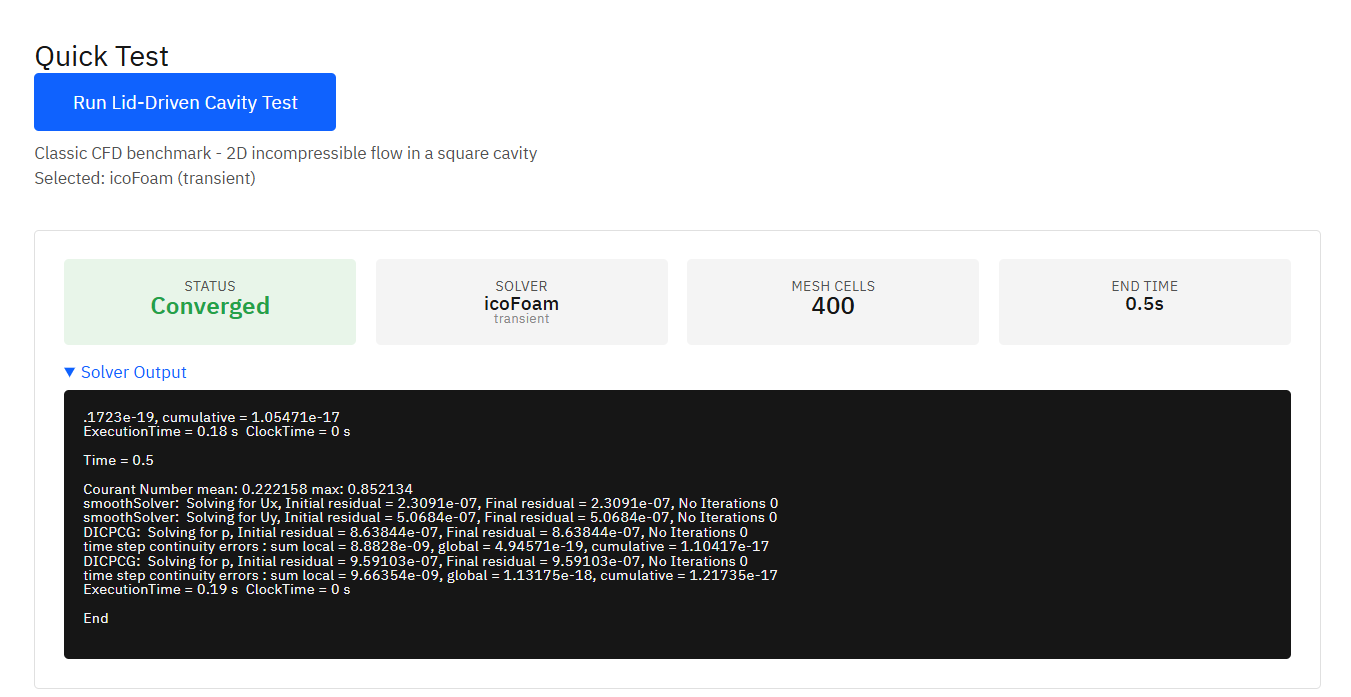
- Cavity — Run the classic lid-driven cavity benchmark case for validating OpenFOAM installations and turbulence models
- Check Mesh — Check OpenFOAM mesh quality (Layer 3).
- Info — Get OpenFOAM model information (Layer 3).
- Mesh — Generate and manage OpenFOAM computational meshes using blockMesh, snappyHexMesh, or cfMesh
- Simulate — Run OpenFOAM CFD simulation with specified solver and boundary conditions
- Solvers — List available OpenFOAM solvers with classification (Layer 3).
- Steady State — Run steady-state OpenFOAM simulation using SIMPLE algorithm solvers
- Transient — Run transient (time-dependent) OpenFOAM simulation using PISO/PIMPLE algorithms
- Utilities — List available OpenFOAM utilities (Layer 3).
Browse the full OpenFOAM skill documentation
Citation
Weller, H.G. et al. A tensorial approach to computational continuum mechanics using object-oriented techniques. Computers in Physics. 12, 620-631 (1998). DOI:10.1063/1.168744
Frequently Asked Questions
What is OpenFOAM?
OpenFOAM is a computing applications (hpc) application available in the Paramus App Store. A computational fluid dynamics (CFD) toolbox for complex fluid flows including incompressible and compressible flow, turbulence modeling, multiphase flows, and heat transfer. Supports both transient and steady-state simulations.
Is OpenFOAM free to use?
Yes. OpenFOAM is distributed under the GPL-3.0 (Free) license and is available at no cost through the Paramus App Store.
How do I install OpenFOAM?
OpenFOAM is installed through Paramus Chemistry OS, an on-premise Windows platform for computational chemistry. Open the Paramus App Store in your local installation and select OpenFOAM for one-click deployment.
What type of application is OpenFOAM?
OpenFOAM belongs to the “Computing Applications (HPC)” category in the Paramus App Store. It runs on Paramus Chemistry OS and can also be accessed through Paramus Cloud for supported workflows.
What platform does OpenFOAM run on?
OpenFOAM runs on Paramus Chemistry OS, a Windows-based on-premise platform that provides local compute power for demanding simulations. It requires a Paramus OS installation with appropriate hardware resources.
Can OpenFOAM be automated or integrated with AI workflows?
Yes. OpenFOAM is available as part of the Paramus ecosystem which supports MCP (Model Context Protocol) tools for AI-driven automation. This enables integration with large language models and automated research pipelines.
How should I cite OpenFOAM in publications?
The recommended citation for OpenFOAM is: Weller, H.G. et al. A tensorial approach to computational continuum mechanics using object-oriented techniques. Computers in Physics. 12, 620-631 (1998). DOI:10.1063/1.168744