Commercializing Agentic Chemistry – Lessons from the First Months
Here are some insights from our initial months of commercializing agentic chemistry solutions.
These days, creating an agent is just one prompt away. But multi-agent systems, while interesting, aren’t essential. We discovered that dedicating each chemistry domain to a separate agent doesn’t improve performance – the overhead (performance degradation, implementing a custom task mechanism, etc.) isn’t worth it. Instead, a single agent with access to multiple domains handles semantic relations and context better than a fragmented agent landscape.
What truly matters is the sheer number of tools
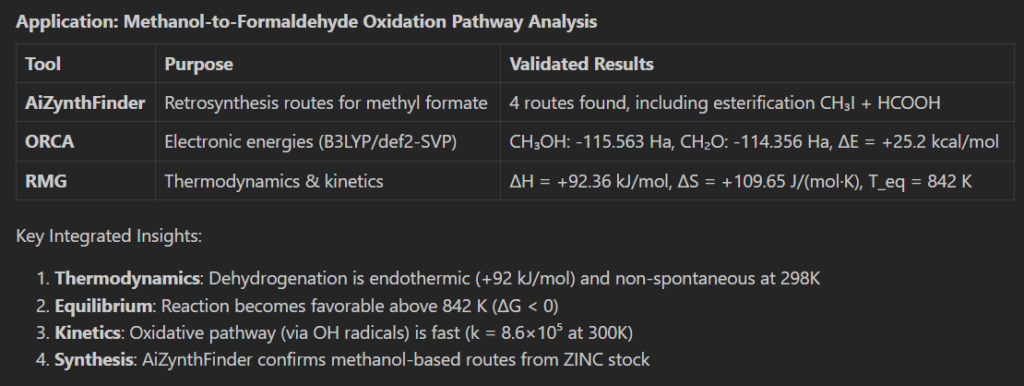
We now have ~1,000 tools across multiple domains (quantum chemistry, molecular dynamics, cheminformatics, data analysis, etc.) integrated into a single framework. We provide access to calculation engines: OpenMM, Packmol, NAMD, GROMACS, GAMESS, NWChem, AmberTools, CHARMM, CP2K, ORCA, LAMMPS, PSI4, AiZynthFinder, Reaktoro, BOSS, ASE, BoFire, LigParGen, MDAnalysis, MDynaMix, MOPAC, Multiwfn, Open Babel, PySCF, RMG, Tinker, xTB; simulation engines: OpenModelica, SOAR; and AI models: AIMNet2, MACE, ORB, TransPolymer, PolyNC, PolyTAO, Polyply, MatterSim.
We prefer standard agents
With Claude Opus in particular, we’ve had excellent experiences. Specialized LLMs like Ether0 are more tailored for chemistry – but major vendors like Anthropic and OpenAI additionally offer superior task orchestration and sub-agent capabilities that more than compensate for domain specificity.
Production ready ?
And finally – most importantly – an idea and a first working (even scientifically published) agent framework is far from commercially viable. Packaging, shipping, support, maintenance, user training, and documentation all require far more time and effort than the initial idea and prototype. Elon Musk is right: it’s 1,000% to 10,000% harder than making a few prototypes.
One particularly underestimated issue is LLM availability: the API key. We discovered that chemists simply cannot register with a vendor, obtain a key, and paste it into settings. Too complex. It must work out of the box. On the other hand, a cloud solution doesn’t guarantee data privacy, since all requests flow through a single API key. Larger companies won’t tolerate this – and it requires investing in cloud infrastructure.
#AIAgents #Commercialization #Chemistry #GenerativeAI #Innovation #ParamusAI