Semantic Information Server
World
- Paramus World is a LLM-driven physical objects representation store, based on knowgledge graph (KG).
- The system is able to learn and update itself from several information sources and text.
- World autonomously model complex relationships and provide context to LLMs.
- Paramus World observes information flow and takes conclusions what to add to the graph.

Pricing, Download and install

Free
Paramus World free tier provides a local knowledge‑graph representation of physical entities (people, substances, equipment) derived from text, enabling lightweight semantic context for small‑scale experimental projects.
SME
The small-medium edition (SME) extends capacity to 50 000 entities and relationships, supporting mid-sized departmental or collaborative R&D projects with richer interlinking and inference density.
$5000 USD*
* per 10k semantic objects, per year
Enterprise
Enterprise tier accommodates up to 1 million physical‑entity items, addressing industrial or multi‑institutional deployments with detailed world‑model representation.
Our system has been validated at the ~80k-object scale. For larger dimensions, we welcome the opportunity to partner with you in exploring and optimizing performance. Get in touch to learn more.
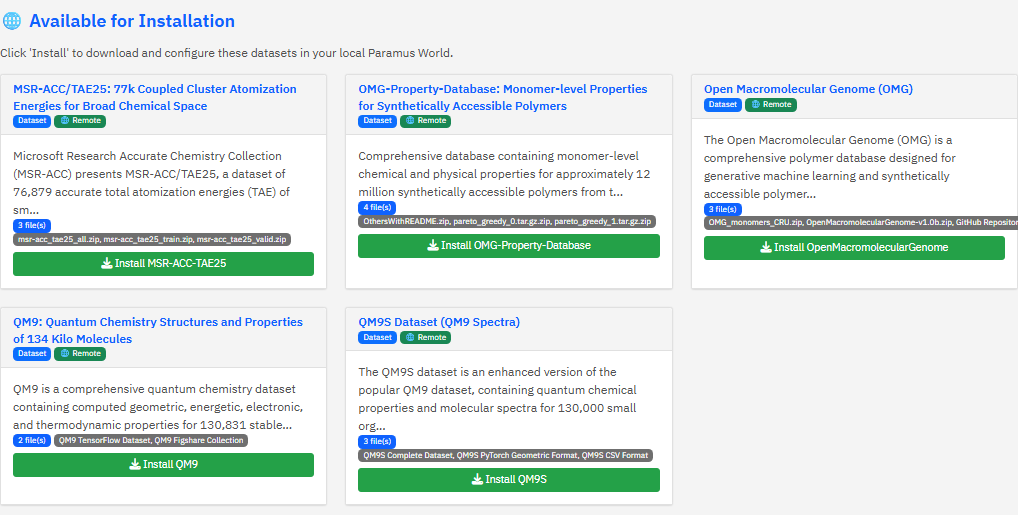
One-click dataset installation
Example: Google Mail Semantic Connector
1.) Email arrives
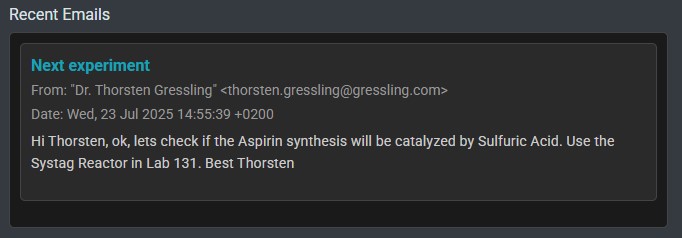
2.) Then one-shot ‘Translated’ into …
1. Physical Entities (categorized by type):

   - People:
       - Dr. Thorsten Gressling
   - Organizations/Companies:
       - Gressling.com
   - Locations, addresses, places:
       - Lab 131
   - Products, devices, equipment:
       - Systag Reactor
   - Physical objects, materials, substances:
       - Aspirin (Substance)
       - Sulfuric Acid (Substance)

2. Relationships between entities:

   - Dr. Thorsten Gressling is part of
     Gressling.com (relationship: partOf)
   - Dr. Thorsten Gressling uses
     the Systag Reactor (relationship: uses)
   - The Systag Reactor is contained
     in Lab 131 (relationship: contains)
   - The Aspirin synthesis involves
     Sulfuric Acid (relationship: involves)
   - The Aspirin synthesis is conducted
     in Lab 131 (relationship: conductedIn)

3. Key insights about the physical world mentioned in these emails:

   - Dr. Thorsten Gressling is conducting
     an experiment involving the synthesis of Aspirin
     catalyzed by Sulfuric Acid.
   - The experiment will be conducted using a Systag
Reactor located in Lab 131.3.) And added to the semantic WORLD database.
4. Result
Chat: "How many reactors we have" - Answer: "There is one reactor in Lab 131"
Integrated JSON-RPC API
- Secure Authentication: JWT Bearer tokens with rate limiting
- JSON-RPC 2.0 Protocol: Full specification compliance
- World Integration: API methods have access to world data
- Available Methods:
chat.submit: Submit messages with world contextsparql.query: Execute SPARQL SELECT queriessparql.update: Execute SPARQL UPDATE operationssystem.health: Get server status and health
FAQ
An RDF-based semantic knowledge graph that stores chemical entities, substances, equipment, people, and experimental data as linked triples. It supports SPARQL queries and provides 120+ JSON-RPC methods across 16 namespaces.
13 datasets including BigSolDB (48,058 solvation free energies), QM9 (133,885 molecules), MaterialsProject (154,718 crystals), ChEMBL (2.4M compounds), ZINC20 (1.4B drug-like molecules), PubChem, PDBe, AFLOW, NOMAD, DrugBank, Tox21, COD, and PolymerGenome.
Three pre-built research databases: polymer chemistry, medicinal chemistry, and germanium extraction. Each contains curated ontologies and domain-specific knowledge.
Yes. The World module is included in the free tier of Paramus Chemistry OS. Dataset installation and SPARQL queries are available without a paid license.
Through the Model Context Protocol (MCP). AI assistants like Claude and ChatGPT can query the knowledge graph, manage entities, install datasets, and run SPARQL queries using 120+ tool endpoints.